

This is the script behind Live Pricing in Detailed Holdings, version 5. It runs in a Google Sheet in your own Google account, so prices come from your account, not ours. Setting it up takes about five minutes, once. After that, copy the script from here whenever the app says yours is out of date.
A visual walkthrough and video are also in Inside Premium: Set up Live Pricing.
Setting it up the first time
You need a Google account (a free one is fine) and Premium Access for Detailed Holdings.
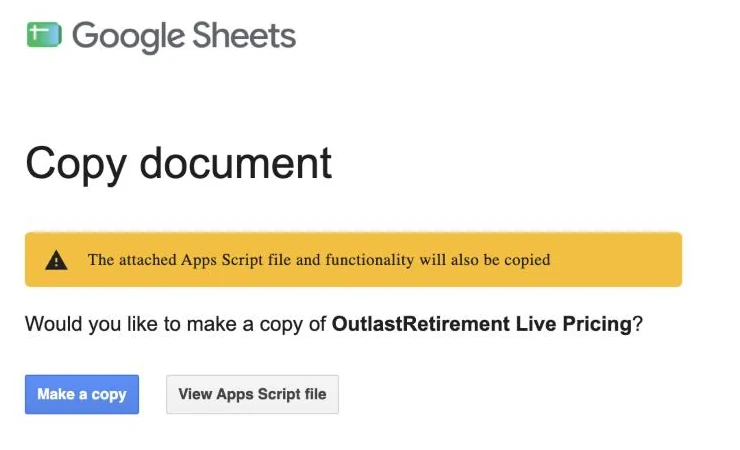
- Press Make your copy of the Sheet. Google asks whether to make a copy; press Make a copy. The script comes with it, and the copy is yours alone.
Show me
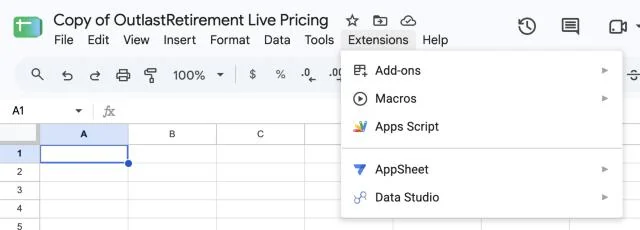
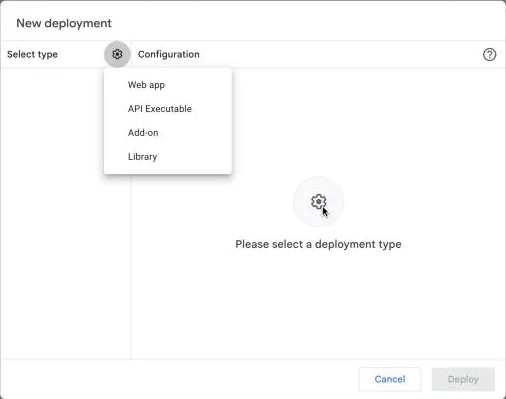
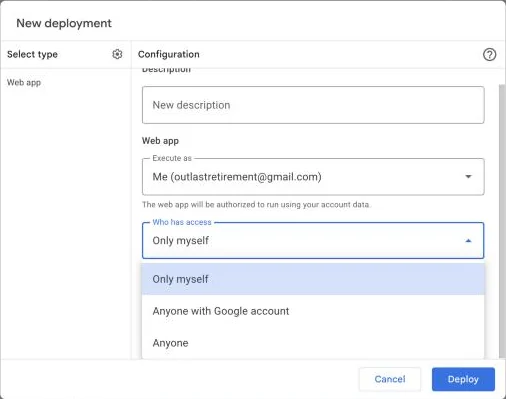
- In your copy, choose Extensions → Apps Script, then Deploy → New deployment. Press the gear beside Select type and choose Web app. Leave Execute as on Me. Change Who has access from Only myself to Anyone (not “Anyone with Google account”, which the app cannot reach), then press Deploy.
Show me
Show me
Show me
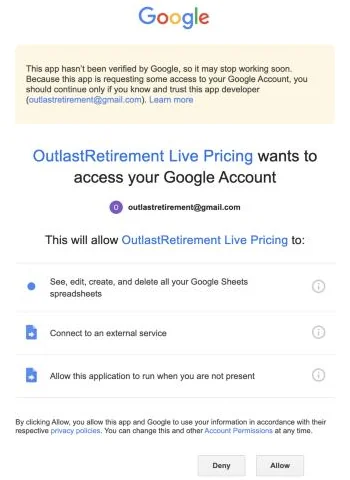
- Google asks you to allow it. Press Authorize access and choose your account. The next screen notes that the app “hasn’t been verified by Google” (it is your own copy, and Google has not reviewed it), lists what it may do, and asks you to press Allow. If Google shows a full page titled Google hasn’t verified this app first, press Advanced, then Go to OutlastRetirement Live Pricing (unsafe).
Show me
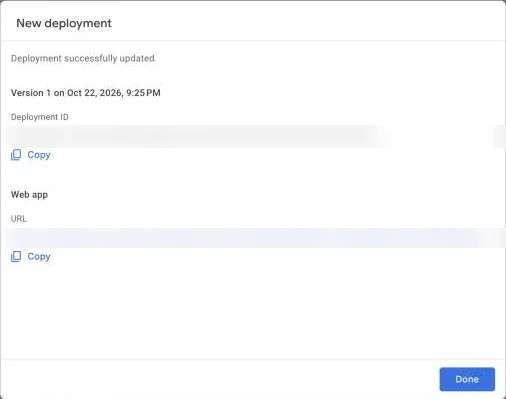
- Copy the Web app address it shows (it ends in
/exec) and press Done.Show me
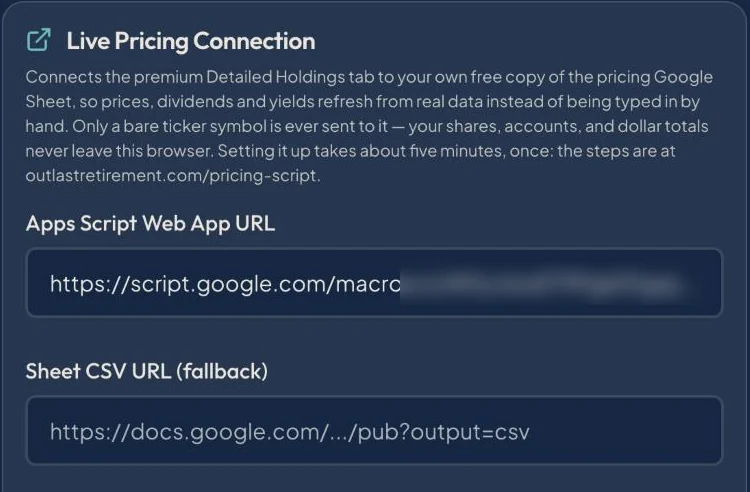
- In the app, open Preferences → Live Pricing Connection and paste it into Apps Script Web App URL.
Show me
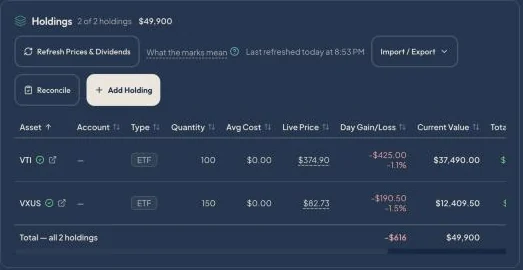
- On Detailed Holdings, press Refresh Prices & Dividends. Your tickers are added to a Securities tab in your Sheet; a new one can take a minute to fill in. From then on the Sheet refreshes itself every six hours.
Show me
What you are allowing: Google asks for three things. “See, edit, create and delete your Google Sheets” is the only Sheets permission Google offers a script; this one reads and writes only the Securities tab of its own copy. “Connect to an external service” is the price lookups at Google Finance and Yahoo Finance. “Run when you are not present” is the six-hour refresh.
Why “Anyone”: the app asks your Sheet for prices without signing in to Google. Only someone with the long address can reach it, and all it answers is prices for ticker symbols. Your shares, accounts and dollar amounts never leave your browser.
Optional backup path: once the Securities tab exists, choose File → Share → Publish to web, pick the Securities tab and Comma-separated values (.csv), press Publish, and paste that address into Sheet CSV URL. Refresh then still works if the Web App has a bad moment.
Updating a script you already use
- Press Copy the script below.
- Open your pricing Google Sheet and choose Extensions → Apps Script.
- Select everything in the editor, paste over it, and press Save.
- Choose Deploy → Manage deployments, press the pencil (Edit), set Version to New version, and press Deploy. The Web App address stays the same.
- Back in the app, press Refresh Prices & Dividends, then dismiss the notice.
From version 5 the script sets up its six-hour refresh by itself. With an older version, run setupRefreshTrigger once from the editor’s Run menu instead.
The script
// Google Apps Script for OutlastRetirement's Live Pricing: a script you
// paste into your own copy of the pricing Sheet (Extensions > Apps Script)
// so the app can read prices and dividends for your holdings. Install and
// update steps: https://www.outlastretirement.com/pricing-script
//
// The canonical copy lives in the app's public repository
// (github.com/jabone/outlastretirement, scripts/pricing-sheet-apps-script.gs);
// the app's "Copy the script" button and the page above serve this file.
// It is not part of the app's build and never runs on our servers.
//
// How it works: doGet() is published as a Web App on your own account and
// answers three requests from the app:
//   ?action=quotes        -> the whole Securities table as JSON, read LIVE
//                            from the Sheet (no publish-to-web lag)
//   ?tickers=A,B,C        -> batch-register several tickers in one call
//   ?ticker=A             -> legacy single-ticker registration (kept so an
//                            older app build still works against this script)
// Publishing the Sheet as CSV is an optional FALLBACK read path -- the app
// prefers ?action=quotes when a Web App URL is connected.
// Everything runs on the user's own free Google account -- no shared API
// key, no per-app-owner cost, no shared rate limit across every user, and
// every cache below (CacheService) is private to this script project on
// the user's own account. Only bare ticker symbols are ever sent here.
//
// Ticker validation and the named-sheet lookup below close two gaps an
// earlier draft of this script had: doGet() used to splice the raw ticker
// parameter directly into formula strings with no character whitelist
// (a crafted ticker could have broken out of the quoted string and
// injected an arbitrary formula), and it wrote to getActiveSheet() --
// whatever tab happened to be open in the UI -- rather than a specific
// named tab.
//
// ── v3 freshness model (READ THIS before touching formulas) ─────────────
// Google Sheets recalculates CUSTOM functions (SMART_DIVIDEND, YAHOO_PRICE,
// etc.) only when their arguments change or the Sheet is opened -- the
// File > Settings > Calculation timed setting only drives NOW/TODAY/RAND,
// and GOOGLEFINANCE refreshes on its own (~20 min). So a mutual fund whose
// price comes from the YAHOO_PRICE fallback went stale until the user
// happened to open the Sheet (observed live with FSELX). v3 fixes this
// with a "refresh salt": every custom-function formula takes $L$1 as a
// dummy extra argument, and the REFRESH_QUOTES trigger below bumps $L$1 on
// a schedule -- changing an argument, which forces every salted cell to
// recalculate. Mutual fund NAVs post once daily after the close, so the
// default every-6-hours trigger is already more than the data needs;
// don't be tempted to run it every minute, that just burns Yahoo calls.

// ── v4: a ticker Yahoo only half knows (READ before touching lookups) ───
// A preferred share (DUK-PA) came back with a price, "Ticker not found" in
// Type, and "HTTP Error 404" in both dividend cells. Three separate causes:
//  1. SECURITY_TYPE called every failed response "Ticker not found", so a
//     throttled request (429) read as a bad ticker. Only a 404 says that
//     now; anything else is "Error: Yahoo returned HTTP <code>", after one
//     retry. Both strings are load-bearing -- see SECURITY_TYPE.
//  2. Yahoo's quoteSummary service has no summary for some securities its
//     chart service prices fine (preferreds, some funds). SMART_DIVIDEND
//     now falls back to the payouts the chart service lists for the last
//     12 months, the same history SMART_FREQUENCY already reads.
//  3. SMART_DIVIDEND passed quoteSummary's error TEXT through as if it were
//     the dividend. Only a number is treated as a value now.

// ── v5: the refresh schedule installs itself ─────────────────────────
// A copy of the template Sheet (a "Make a copy" link) brings this script
// with it, but Google never copies triggers, and running setupRefreshTrigger
// by hand was the step most people missed. ensureRefreshTrigger_() now runs
// on each request from the app: if this account has no REFRESH_QUOTES
// trigger, it adds one. It looks at most once every six hours (a CacheService
// note, private to this script) and never lets a failure stop the request.
// setupRefreshTrigger still works from the editor, as before.

// ── Configuration ──────────────────────────────────────────────────
// Reported in every JSON reply. Bump with PRICING_SHEET_SCRIPT_VERSION in
// the app's sheetPricing.js.
var SCRIPT_VERSION = 5;

// Name of the tab that stores ticker data. Must match your Sheet's tab
// name exactly (case-sensitive). If the tab doesn't exist yet, doGet()
// creates it automatically with a header row on first use.
var SHEET_NAME = "Securities";

// The refresh-salt cell (see the freshness model note above). Lives on the
// header row past the data columns so the CSV parser (which reads columns
// A-I and skips row 1) never sees it. K1 is a human-readable label; L1 is
// the timestamp the trigger bumps.
var SALT_LABEL_CELL = "K1";
var SALT_CELL = "L1";
// How the formulas reference the salt. $-anchored so a row copy/paste
// can't drift it.
var SALT_REF = "$L$1";

// How many tickers one batch registration call will accept. Generous --
// the app sends one batch per Refresh with only the symbols missing from
// the Sheet -- while still bounding a single Web App execution.
var MAX_BATCH_TICKERS = 50;

// Cache TTLs (seconds). CacheService is scoped to this script project on
// YOUR Google account -- there is no shared or third-party cache server.
var TTL_PRICE = 1800;      // 30 min -- prices move; mutual fund NAV is daily anyway
var TTL_MODULE = 14400;    // 4 h  -- dividend rate/yield change rarely
var TTL_FREQUENCY = 86400; // 24 h -- payout cadence changes ~never
var TTL_TYPE = 86400;      // 24 h -- security type changes ~never
var TTL_AUTH = 21600;      // 6 h  -- Yahoo cookie+crumb session

// Allowed ticker shapes: plain tickers (AAPL, FXAIX), share classes
// (BRK-B, BF.B), and index tickers (^GSPC). 1-10 core chars, optional
// leading "^", optional "." or "-" suffix of 1-5 chars. Deliberately
// excludes quotes, parens, "=", ";", spaces, etc. so a crafted ticker
// value can't break out of the quoted string inside a formula.
var TICKER_PATTERN = /^\^?[A-Z0-9]{1,10}([.\-][A-Z0-9]{1,5})?$/;

function isValidTicker_(ticker) {
  return TICKER_PATTERN.test(ticker);
}

// ── One-time setup helpers (run these from the Apps Script editor) ─────

/**
 * Run ONCE from the editor (Run > setupRefreshTrigger) after pasting this
 * script: installs the time-driven trigger that keeps custom-function
 * cells fresh without the Sheet being open. Safe to re-run -- it removes
 * any previous trigger for REFRESH_QUOTES before adding the new one.
 * Every 6 hours by default; NAVs post once daily after market close, so
 * this cadence already over-covers the data's real update rate.
 */
function setupRefreshTrigger() {
  removeRefreshTrigger();
  ScriptApp.newTrigger("REFRESH_QUOTES").timeBased().everyHours(6).create();
}

/**
 * Adds the REFRESH_QUOTES trigger when this account has none (v5). Called
 * on every Web App request; checks at most once per six hours. Any failure
 * (a missing permission, a quota) is swallowed: prices still come back,
 * and the next check tries again.
 */
function ensureRefreshTrigger_() {
  try {
    var cache = CacheService.getScriptCache();
    if (cache.get("refresh_trigger_checked")) return;
    var triggers = ScriptApp.getProjectTriggers();
    var found = false;
    for (var i = 0; i < triggers.length; i++) {
      if (triggers[i].getHandlerFunction() === "REFRESH_QUOTES") { found = true; break; }
    }
    if (!found) ScriptApp.newTrigger("REFRESH_QUOTES").timeBased().everyHours(6).create();
    cache.put("refresh_trigger_checked", "1", 21600);
  } catch (err) {
    // Leave it for the next request.
  }
}

/** Removes the REFRESH_QUOTES trigger(s). Run from the editor if you want
 *  to stop scheduled refreshes entirely. */
function removeRefreshTrigger() {
  var triggers = ScriptApp.getProjectTriggers();
  for (var i = 0; i < triggers.length; i++) {
    if (triggers[i].getHandlerFunction() === "REFRESH_QUOTES") {
      ScriptApp.deleteTrigger(triggers[i]);
    }
  }
}

/**
 * The scheduled refresh (also safe to run by hand from the editor).
 * 1. Migrates any v2-era rows to salted formulas (one-time per row --
 *    only cells that currently CONTAIN a formula are rewritten, so a cell
 *    you've hand-edited to a static value is left alone).
 * 2. Bumps the salt cell, which forces every salted custom-function cell
 *    to recalculate. GOOGLEFINANCE cells keep their own ~20-min refresh
 *    cycle and are untouched.
 */
function REFRESH_QUOTES() {
  var ss = SpreadsheetApp.getActiveSpreadsheet();
  var sheet = ss.getSheetByName(SHEET_NAME);
  if (!sheet) return;
  ensureSaltedFormulas_(sheet);
  sheet.getRange(SALT_LABEL_CELL).setValue("Refreshed");
  sheet.getRange(SALT_CELL).setValue(new Date());
  SpreadsheetApp.flush();
}

// Canonical formula set for one ticker's row, columns B..I. The single
// source of truth used by registration AND the v2->v3 migration, so the
// two can never drift apart.
function rowFormulas_(ticker) {
  return [
    '=SECURITY_TYPE("' + ticker + '", ' + SALT_REF + ')',                                            // B: Type (live formula, self-heals from a transient lookup failure)
    '=IFERROR(GOOGLEFINANCE("' + ticker + '", "price"), YAHOO_PRICE("' + ticker + '", ' + SALT_REF + '))', // C: Price (Yahoo fallback -- GOOGLEFINANCE has known gaps for open-end mutual funds)
    '=IFERROR(GOOGLEFINANCE("' + ticker + '", "change"), "")',                                       // D: Change
    '=IFERROR(GOOGLEFINANCE("' + ticker + '", "changepct"), "")',                                    // E: ChangePct
    '=SMART_FREQUENCY("' + ticker + '", ' + SALT_REF + ')',                                          // F: Payout Freq (calculated from real payout history)
    '=SMART_DIVIDEND("' + ticker + '", "dollar", ' + SALT_REF + ')',                                 // G: Dividend ($)
    '=SMART_DIVIDEND("' + ticker + '", "yield", ' + SALT_REF + ')',                                  // H: Yield (%)
    '="https://finance.yahoo.com/quote/"&"' + ticker + '"',                                          // I: URL
  ];
}

// v2 rows have formulas without the salt argument, which never recalculate
// on a schedule. Rewrite each formula-bearing cell in columns B..H to the
// salted canonical version (I has no custom function; D/E are pure
// GOOGLEFINANCE and get rewritten harmlessly to the same text). Cells with
// NO formula (hand-entered static values) are deliberately skipped.
function ensureSaltedFormulas_(sheet) {
  var lastRow = sheet.getLastRow();
  if (lastRow < 2) return;
  var dataRange = sheet.getRange(2, 1, lastRow - 1, 9); // A..I
  var values = dataRange.getValues();
  var formulas = dataRange.getFormulas();
  for (var r = 0; r < formulas.length; r++) {
    var ticker = (values[r][0] || "").toString().toUpperCase().trim();
    if (!ticker || !isValidTicker_(ticker)) continue;
    var canonical = rowFormulas_(ticker);
    for (var c = 1; c <= 8; c++) { // sheet columns B..I
      var existing = formulas[r][c];
      if (!existing) continue;                      // static value -- leave the user's edit alone
      if (existing.indexOf(SALT_REF) !== -1) continue; // already salted
      var target = canonical[c - 1];
      if (existing === target) continue;            // already canonical (e.g. URL/GOOGLEFINANCE-only columns)
      sheet.getRange(r + 2, c + 1).setFormula(target);
    }
  }
}

// ── Web App entry point ────────────────────────────────────────────

function doGet(e) {
  var p = (e && e.parameter) || {};
  ensureRefreshTrigger_();

  if (p.action === "quotes") return serveQuotes_();
  if (p.tickers) return registerBatch_(p.tickers);

  // Legacy single-ticker path -- same plain-text protocol v2 spoke, so an
  // older app build pointed at this script keeps working unchanged.
  var ticker = p.ticker;
  if (!ticker) return ContentService.createTextOutput("No ticker provided.");

  ticker = ticker.toUpperCase().replace("MUTF:", "").trim();
  if (!isValidTicker_(ticker)) {
    return ContentService.createTextOutput("Invalid ticker format: " + ticker);
  }

  var lock = LockService.getScriptLock();
  if (!lock.tryLock(30000)) {
    return ContentService.createTextOutput("Busy, try again: " + ticker);
  }
  try {
    var status = registerOne_(getOrCreateSheet_(), ticker);
    return ContentService.createTextOutput(status).setMimeType(ContentService.MimeType.TEXT);
  } finally {
    lock.releaseLock();
  }
}

// The whole Securities table, read live from the Sheet and returned as
// JSON -- the app's preferred read path. Published-CSV reads lag behind
// the live Sheet by Google's ~5-minute republish cadence; this endpoint
// doesn't, which is what lets a Refresh see a just-registered ticker's
// values as soon as its formulas resolve.
function serveQuotes_() {
  var ss = SpreadsheetApp.getActiveSpreadsheet();
  var sheet = ss.getSheetByName(SHEET_NAME);
  var quotes = {};
  if (sheet) {
    var lastRow = sheet.getLastRow();
    if (lastRow >= 2) {
      var values = sheet.getRange(2, 1, lastRow - 1, 9).getValues(); // A..I
      for (var i = 0; i < values.length; i++) {
        var symbol = (values[i][0] || "").toString().toUpperCase().trim();
        if (!symbol) continue;
        quotes[symbol] = {
          type: values[i][1],
          price: values[i][2],
          change: values[i][3],
          changePct: values[i][4],
          payoutFreq: values[i][5],
          dividend: values[i][6],
          yield: values[i][7],
          url: values[i][8],
        };
      }
    }
  }
  return ContentService
    .createTextOutput(JSON.stringify({ ok: true, version: SCRIPT_VERSION, quotes: quotes }))
    .setMimeType(ContentService.MimeType.JSON);
}

// Batch registration: one Web App call, one lock, one sheet read for the
// whole list -- replaces the app calling the single-ticker path once per
// symbol (each call is a fresh Apps Script cold start, so ten new symbols
// used to cost ten cold starts plus stagger delays). Returns per-ticker
// statuses as JSON so the app can tell "registered", "already there",
// and "rejected" apart instead of assuming every HTTP 200 succeeded.
function registerBatch_(tickersParam) {
  var results = {};
  var raw = tickersParam.split(",");
  if (raw.length > MAX_BATCH_TICKERS) {
    return ContentService
      .createTextOutput(JSON.stringify({ ok: false, version: SCRIPT_VERSION, error: "Too many tickers in one call (max " + MAX_BATCH_TICKERS + ")" }))
      .setMimeType(ContentService.MimeType.JSON);
  }

  var lock = LockService.getScriptLock();
  if (!lock.tryLock(30000)) {
    return ContentService
      .createTextOutput(JSON.stringify({ ok: false, version: SCRIPT_VERSION, error: "Busy, try again" }))
      .setMimeType(ContentService.MimeType.JSON);
  }
  try {
    var sheet = getOrCreateSheet_();
    for (var i = 0; i < raw.length; i++) {
      var ticker = raw[i].toUpperCase().replace("MUTF:", "").trim();
      if (!ticker) continue;
      if (!isValidTicker_(ticker)) {
        results[ticker] = "Invalid";
        continue;
      }
      results[ticker] = registerOne_(sheet, ticker);
    }
    return ContentService
      .createTextOutput(JSON.stringify({ ok: true, version: SCRIPT_VERSION, results: results }))
      .setMimeType(ContentService.MimeType.JSON);
  } finally {
    lock.releaseLock();
  }
}

function getOrCreateSheet_() {
  var ss = SpreadsheetApp.getActiveSpreadsheet();
  var sheet = ss.getSheetByName(SHEET_NAME);
  if (!sheet) {
    // First run against a fresh copy of the template: create the tab with
    // headers instead of silently writing to whatever tab happens to be
    // open.
    sheet = ss.insertSheet(SHEET_NAME);
    sheet.appendRow(["Ticker", "Type", "Price", "Change", "ChangePct",
                      "PayoutFreq", "Dividend", "Yield", "URL"]);
    sheet.getRange(SALT_LABEL_CELL).setValue("Refreshed");
    sheet.getRange(SALT_CELL).setValue(new Date());
  }
  return sheet;
}

// Appends one ticker's formula row if it isn't present. Caller must hold
// the script lock. Returns "Success" or "Exists".
function registerOne_(sheet, ticker) {
  var data = sheet.getDataRange().getValues();
  for (var i = 0; i < data.length; i++) {
    if (data[i][0] && data[i][0].toString().toUpperCase() === ticker) {
      return "Exists";
    }
  }
  // We split the Dividend and Yield into two separate columns!
  sheet.appendRow([ticker].concat(rowFormulas_(ticker)));
  return "Success";
}

// ── Yahoo Finance lookups (cached) ─────────────────────────────────
//
// All caches below are CacheService.getScriptCache() -- storage private to
// this script project on the user's own Google account, NOT any shared or
// third-party server. Caching matters because Sheets recalculates BOTH
// SMART_DIVIDEND cells (dollar + yield) independently, and each used to
// re-fetch the same Yahoo module -- with the scheduled REFRESH_QUOTES
// bumping recalculation several times a day, uncached lookups would
// multiply Yahoo traffic for data (dividend rates, payout cadence) that
// barely changes week to week. Only SUCCESSFUL lookups are cached; error
// responses always retry live.

// One request to Yahoo's chart service (no cookie or crumb needed), shared
// by every lookup below. Returns { code, json }: json is the parsed body on
// a 200 and null otherwise. A 404 is Yahoo saying it does not know the
// ticker and is final; any other failure (throttling, a hiccup) is retried
// once after a short pause, because a row's cells all recalculate together
// and the burst is what gets throttled.
function fetchChart_(cleanTicker, query) {
  var url = "https://query1.finance.yahoo.com/v8/finance/chart/" + encodeURIComponent(cleanTicker) + "?" + query;
  var options = {
    "muteHttpExceptions": true,
    "headers": { "User-Agent": "Mozilla/5.0 (Windows NT 10.0; Win64; x64) AppleWebKit/537.36" }
  };
  var code = 0;
  for (var attempt = 0; attempt < 2; attempt++) {
    if (attempt > 0) Utilities.sleep(1500);
    var response = UrlFetchApp.fetch(url, options);
    code = response.getResponseCode();
    if (code === 200) return { code: 200, json: JSON.parse(response.getContentText()) };
    if (code === 404) break;
  }
  return { code: code, json: null };
}

// The dividends actually paid over the last 12 months, added up, or null
// when Yahoo lists none (or the lookup failed). The fallback for a security
// quoteSummary has no summary for -- see the v4 note at the top. For a
// fixed-rate preferred this IS the annual dividend; for anything else it is
// what was paid, not a forecast.
function trailingDividends_(cleanTicker) {
  var cache = CacheService.getScriptCache();
  var cached = cache.get("ttm_" + cleanTicker);
  if (cached !== null) {
    var num = parseFloat(cached);
    return isNaN(num) ? null : num;
  }
  try {
    var chart = fetchChart_(cleanTicker, "events=div&interval=1d&range=1y");
    if (chart.code !== 200) return null;
    var result = chart.json.chart && chart.json.chart.result && chart.json.chart.result[0];
    var divs = result && result.events && result.events.dividends;
    if (!divs) return null;
    var total = 0;
    var keys = Object.keys(divs);
    for (var i = 0; i < keys.length; i++) {
      var amount = divs[keys[i]].amount;
      if (typeof amount === "number") total += amount;
    }
    if (!(total > 0)) return null;
    total = Math.round(total * 10000) / 10000;
    cache.put("ttm_" + cleanTicker, String(total), TTL_MODULE);
    return total;
  } catch (e) {
    return null;
  }
}

/**
 * Deduces dividend payout frequency by counting actual payouts over the last 12 months.
 * The trailing _salt argument is unused -- it exists so the REFRESH_QUOTES
 * trigger can force recalculation by changing it (see the freshness model
 * note at the top).
 *
 * @customfunction
 */
function SMART_FREQUENCY(ticker, _salt) {
  if (!ticker) return "N/A";
  var cleanTicker = ticker.toString().replace("MUTF:", "").trim().toUpperCase();

  var cache = CacheService.getScriptCache();
  var cached = cache.get("freq_" + cleanTicker);
  if (cached) return cached;

  // Look at the chart API for the last 1 year of dividend events (interval=1d prevents Yahoo from aggregating weekly dividends)
  try {
    var chart = fetchChart_(cleanTicker, "events=div&interval=1d&range=1y");
    if (chart.code !== 200) return "N/A";

    var json = chart.json;
    var label;
    if (!json.chart || !json.chart.result || !json.chart.result[0].events || !json.chart.result[0].events.dividends) {
      // If Yahoo explicitly has no dividend history, check if it's yielding anything
      var yld = YAHOO_FINANCE(cleanTicker, "summaryDetail", "yield") || YAHOO_FINANCE(cleanTicker, "summaryDetail", "dividendYield");
      // Only a real yield counts; an error string from the summary lookup
      // used to count as one, and "Unknown" was then cached for a day.
      label = (typeof yld === "number" && yld > 0) ? "Unknown" : "None";
      cache.put("freq_" + cleanTicker, label, TTL_FREQUENCY);
      return label;
    }

    // Sort historical dividends chronologically
    var divs = json.chart.result[0].events.dividends;
    var keys = Object.keys(divs).sort(function(a, b) { return a - b; });
    var count = keys.length;
    if (count === 0) return "None";

    var dates = [];
    for (var i = 0; i < keys.length; i++) dates.push(new Date(keys[i] * 1000));
    var lastDate = dates[dates.length - 1];

    var monthNames = ["Jan", "Feb", "Mar", "Apr", "May", "Jun", "Jul", "Aug", "Sep", "Oct", "Nov", "Dec"];
    var dayNames = ["Sundays", "Mondays", "Tuesdays", "Wednesdays", "Thursdays", "Fridays", "Saturdays"];

    if (count >= 48 && count <= 54) {
      label = "Weekly (" + dayNames[lastDate.getDay()] + ")";
    } else if (count >= 11 && count <= 13) {
      var avgDay = 0;
      for (var d = 0; d < dates.length; d++) avgDay += dates[d].getDate();
      avgDay = Math.round(avgDay / dates.length);
      var timing = "Late-Month";
      if (avgDay <= 10) timing = "Early-Month";
      else if (avgDay <= 20) timing = "Mid-Month";
      label = "Monthly (" + timing + ")";
    } else if (count >= 3 && count <= 5) {
      var recent = dates.slice(Math.max(dates.length - 4, 0));
      recent.sort(function(a, b) { return a.getMonth() - b.getMonth(); });
      var qMonths = [];
      for (var q = 0; q < recent.length; q++) {
        var m = monthNames[recent[q].getMonth()];
        if (qMonths.indexOf(m) === -1) qMonths.push(m);
      }
      label = "Quarterly (" + qMonths.join("/") + ")";
    } else if (count === 2) {
      var m1 = monthNames[dates[0].getMonth()];
      var m2 = monthNames[dates[1].getMonth()];
      label = "Semi-Annually (" + m1 + "/" + m2 + ")";
    } else if (count === 1) {
      label = "Annually (" + monthNames[lastDate.getMonth()] + ")";
    } else {
      label = count + "x / Year";
    }

    cache.put("freq_" + cleanTicker, label, TTL_FREQUENCY);
    return label;

  } catch (e) {
    return "N/A";
  }
}

/**
 * Automatically hunts down the correct dividend or yield field in Yahoo Finance.
 * Derives missing values using Live Price. The trailing _salt argument is
 * unused -- see SMART_FREQUENCY.
 *
 * @customfunction
 */
function SMART_DIVIDEND(ticker, requestType, _salt) {
  if (!ticker) return "N/A";

  // 1. Fetch the raw rate (Dollars) and raw yield (Percentage). These go
  // through the cached YAHOO_FINANCE wrapper, so the dollar cell and the
  // yield cell -- which need the same summaryDetail fields -- share one
  // real fetch instead of each redoing it.
  // Only a NUMBER is a value. Everything else YAHOO_FINANCE returns is one
  // of: "N/A" (the summary has no such field), a no-summary answer
  // ("HTTP Error 404" / "Ticker not found" -- Yahoo has no summary for this
  // security at all), or a passing failure ("Error: ...", another HTTP code).
  var num = function(v) { return typeof v === "number" ? v : null; };
  var noSummary = function(v) { return v === "HTTP Error 404" || v === "Ticker not found"; };
  var failure = function(v) { return typeof v === "string" && v !== "N/A" && v !== "" && !noSummary(v); };

  var rawRate = YAHOO_FINANCE(ticker, "summaryDetail", "dividendRate");
  var rate = num(rawRate);
  var rawYld = YAHOO_FINANCE(ticker, "summaryDetail", "dividendYield");
  var yld = num(rawYld);
  // With no summary at all, the other fields are not there either: don't
  // spend two more requests asking.
  if (yld === null && !noSummary(rawYld)) yld = num(YAHOO_FINANCE(ticker, "summaryDetail", "yield"));
  if (yld === null && !noSummary(rawYld)) yld = num(YAHOO_FINANCE(ticker, "defaultKeyStatistics", "yield"));

  if (rate === null && yld === null) {
    // A passing failure is reported as it always was, so the cell says what
    // went wrong and the next refresh retries.
    if (failure(rawRate)) return rawRate;
    if (failure(rawYld)) return rawYld;
    // No summary for this security: use what it actually paid.
    if (noSummary(rawRate) || noSummary(rawYld)) {
      var cleanTicker = ticker.toString().replace("MUTF:", "").trim().toUpperCase();
      rate = trailingDividends_(cleanTicker);
    }
  }
  // 2. Return the requested format, deriving it mathematically if it's missing!
  if (requestType === "dollar") {
    if (rate !== null) return rate; // We have the exact dollar amount
    if (yld !== null) {
      // Derive: Dollar = Yield * Price
      var price = YAHOO_PRICE(ticker);
      if (typeof price === "number") return yld * price;
    }
    return "N/A";
  }
  if (requestType === "yield") {
    if (yld !== null) return yld; // We have the exact percentage
    if (rate !== null) {
      // Derive: Yield = Dollar / Price
      var price2 = YAHOO_PRICE(ticker);
      if (typeof price2 === "number" && price2 > 0) return rate / price2;
    }
    return "N/A";
  }
  return "N/A";
}

/**
 * Detects whether a ticker is a Stock, ETF, Mutual Fund, Crypto, or Index.
 * The trailing _salt argument is unused -- see SMART_FREQUENCY.
 *
 * NOTE: the "Ticker not found" / "Error: ..." return strings are load-
 * bearing -- the app's getSheetSyncStatus (sheetPricing.js) classifies
 * per-symbol badges off exactly these strings. Don't reword them.
 * "Ticker not found" is returned ONLY for a 404 (v4).
 */
function SECURITY_TYPE(ticker, _salt) {
  if (!ticker) return "";

  var cleanTicker = ticker.toString().replace("MUTF:", "").trim().toUpperCase();

  var cache = CacheService.getScriptCache();
  var cachedType = cache.get("type_" + cleanTicker);
  if (cachedType) return cachedType;
  try {
    var chart = fetchChart_(cleanTicker, "interval=1d&range=1d");
    // Only a 404 means Yahoo does not know the ticker. Anything else is a
    // failed request, and saying "not found" for it sent people hunting for
    // a typo that was not there.
    if (chart.code === 404) return "Ticker not found";
    if (chart.code !== 200) return "Error: Yahoo returned HTTP " + chart.code;
    var json = chart.json;
    if (!json.chart || !json.chart.result || json.chart.result.length === 0) return "Unknown";
    var rawType = json.chart.result[0].meta.instrumentType || "";
    var formattedType = "Unknown";
    switch (rawType.toUpperCase()) {
      case "EQUITY": formattedType = "Stock"; break;
      case "ETF": formattedType = "ETF"; break;
      case "MUTUALFUND": formattedType = "Mutual Fund"; break;
      case "INDEX": formattedType = "Index"; break;
      case "CRYPTOCURRENCY": formattedType = "Crypto"; break;
      case "CURRENCY": formattedType = "Currency / Forex"; break;
      case "FUTURE": formattedType = "Futures"; break;
      default: formattedType = rawType || "Unknown";
    }
    cache.put("type_" + cleanTicker, formattedType, TTL_TYPE);
    return formattedType;
  } catch (e) {
    return "Error: " + e.message;
  }
}

/**
 * Custom function to fetch Yahoo Finance statistics. Successful lookups
 * are cached (module data for 4 h) so repeated recalculations don't
 * re-hit Yahoo for data that barely changes; failures are never cached.
 */
function YAHOO_FINANCE(ticker, moduleName, dataPoint) {
  if (!ticker || !moduleName || !dataPoint) return "Missing parameters";

  var cleanTicker0 = ticker.toString().replace("MUTF:", "").trim().toUpperCase();
  var cache = CacheService.getScriptCache();
  var cacheKey = "yf_" + cleanTicker0 + "_" + moduleName + "_" + dataPoint;
  var cached = cache.get(cacheKey);
  if (cached !== null) {
    try { return JSON.parse(cached).v; } catch (ignored) { /* fall through to live fetch */ }
  }

  try {
    var auth = getYahooAuth_();
    if (!auth || !auth.crumb) return "Error: Yahoo auth failed";
    var cleanTicker = ticker.toString().replace("MUTF:", "").trim();
    var url = "https://query1.finance.yahoo.com/v10/finance/quoteSummary/" +
              encodeURIComponent(cleanTicker) +
              "?modules=" + encodeURIComponent(moduleName) +
              "&crumb=" + encodeURIComponent(auth.crumb);
    var options = {
      "method": "get",
      "muteHttpExceptions": true,
      "headers": {
        "User-Agent": "Mozilla/5.0 (Macintosh; Intel Mac OS X 10_15_7) AppleWebKit/537.36 (KHTML, like Gecko) Chrome/122.0.0.0 Safari/537.36",
        "Cookie": auth.cookie
      }
    };
    var response = UrlFetchApp.fetch(url, options);
    if (response.getResponseCode() !== 200) {
      // A 404 is about the ticker (no summary for it), not the session;
      // dropping the session for it made every later lookup sign in again.
      if (response.getResponseCode() !== 404) CacheService.getScriptCache().remove("yahoo_auth");
      return "HTTP Error " + response.getResponseCode();
    }
    var json = JSON.parse(response.getContentText());
    if (!json.quoteSummary || !json.quoteSummary.result || json.quoteSummary.result.length === 0) {
      return "Ticker not found";
    }
    var moduleObj = json.quoteSummary.result[0][moduleName];
    if (!moduleObj || moduleObj[dataPoint] === undefined) {
      return "N/A";
    }
    var result = moduleObj[dataPoint];

    // Yahoo sometimes returns empty objects {} for missing data
    if (result && typeof result === "object") {
      if (Object.keys(result).length === 0) return "N/A";

      if (dataPoint.toLowerCase().includes("date") && result.raw) {
        result = result.fmt || new Date(result.raw * 1000).toISOString().split("T")[0];
      } else if (result.raw !== undefined) {
        result = result.raw;
      }
    }

    // Cache only real values -- numbers and non-error strings. "N/A" is a
    // real (negative) answer worth caching too, so a no-dividend stock
    // doesn't re-fetch its empty summaryDetail on every recalculation.
    if (typeof result === "number" || (typeof result === "string" && result.indexOf("Error") === -1 && result.indexOf("HTTP") === -1)) {
      cache.put(cacheKey, JSON.stringify({ v: result }), TTL_MODULE);
    }
    return result;
  } catch (err) {
    return "Error: " + err.message;
  }
}

/**
 * Price fallback for tickers GOOGLEFINANCE can't resolve (e.g. many
 * open-end mutual funds). v3: reads Yahoo's v8 chart endpoint, which
 * needs no cookie/crumb session at all (same endpoint SECURITY_TYPE
 * already uses) -- one less fragile moving part than the old
 * quoteSummary+crumb flow -- and caches the price for 30 minutes.
 * Returns a plain number so IFERROR(...) in the Price column formula can
 * use it as a drop-in second argument; returns "" (blank cell, not an
 * error string) for anything Yahoo couldn't resolve, so a bad lookup
 * never gets treated as a price. The trailing _salt argument is unused --
 * see SMART_FREQUENCY.
 *
 * @customfunction
 */
function YAHOO_PRICE(ticker, _salt) {
  if (!ticker) return "";
  var cleanTicker = ticker.toString().replace("MUTF:", "").trim().toUpperCase();

  var cache = CacheService.getScriptCache();
  var cached = cache.get("price_" + cleanTicker);
  if (cached !== null) {
    var num = parseFloat(cached);
    if (!isNaN(num)) return num;
  }

  try {
    var chart = fetchChart_(cleanTicker, "interval=1d&range=1d");
    if (chart.code !== 200) return "";
    var json = chart.json;
    var meta = json.chart && json.chart.result && json.chart.result[0] && json.chart.result[0].meta;
    var price = meta && meta.regularMarketPrice;
    if (typeof price !== "number") return "";
    cache.put("price_" + cleanTicker, String(price), TTL_PRICE);
    return price;
  } catch (e) {
    return "";
  }
}

/**
 * Session auth token helper for Yahoo Finance (still used by
 * YAHOO_FINANCE's quoteSummary lookups -- dividend rate/yield).
 */
function getYahooAuth_() {
  var cache = CacheService.getScriptCache();
  var cachedAuth = cache.get("yahoo_auth");
  if (cachedAuth) return JSON.parse(cachedAuth);
  var userAgent = "Mozilla/5.0 (Macintosh; Intel Mac OS X 10_15_7) AppleWebKit/537.36 (KHTML, like Gecko) Chrome/122.0.0.0 Safari/537.36";
  var init = UrlFetchApp.fetch("https://fc.yahoo.com", { "muteHttpExceptions": true, "headers": { "User-Agent": userAgent } });
  var rawCookie = init.getAllHeaders()["Set-Cookie"] || init.getAllHeaders()["set-cookie"];
  var cookieStr = Array.isArray(rawCookie) ? rawCookie.map(function(c) { return c.split(";")[0]; }).join("; ") : (rawCookie ? rawCookie.split(";")[0] : "");
  var crumbResp = UrlFetchApp.fetch("https://query2.finance.yahoo.com/v1/test/getcrumb", {
    "muteHttpExceptions": true,
    "headers": { "User-Agent": userAgent, "Cookie": cookieStr }
  });
  var crumb = crumbResp.getContentText();
  if (!crumb || crumb.length > 50 || crumb.indexOf("<") !== -1) return null;
  var authObj = { cookie: cookieStr, crumb: crumb };
  cache.put("yahoo_auth", JSON.stringify(authObj), TTL_AUTH);
  return authObj;
}
What changed in each version
- Version 5 (2026-10-22). The scheduled refresh now sets itself up the first time the app connects, so a new copy of the pricing Sheet no longer needs setupRefreshTrigger run by hand. If you already ran it, nothing changes for you: updating is optional.
- Version 4 (2026-10-05). Fixes for securities Yahoo Finance only partly covers, such as preferred shares. A throttled lookup is retried and, if it still fails, reported as an error instead of “Ticker not found”. When Yahoo has no dividend summary for a security, the dividend and yield now come from what it actually paid over the last 12 months, instead of showing “HTTP Error 404”. Nothing new to run after pasting: redeploy as a new version and the next refresh picks it up.
- Version 3 (2026-08-21). Four upgrades: (1) a scheduled refresh keeps prices fresh without opening the Sheet — custom-function cells (like mutual fund NAV fallbacks) previously only recalculated when the Sheet was opened; after pasting the new script, run setupRefreshTrigger once from the Apps Script editor to install it. (2) New tickers register in one batched call instead of one call each, and rejected tickers now report why. (3) Yahoo lookups are cached in your own script's storage (never any shared server), cutting repeat traffic ~10x. (4) The app now reads quotes as JSON straight from your Web App, skipping the published-CSV's ~5-minute republish lag; the CSV URL still works as a fallback.
- Version 2 (2026-08-19). Added a Yahoo-based price fallback for tickers GOOGLEFINANCE can't resolve (fixes stale/missing prices for some mutual funds), made the Type column a live formula so it self-heals from a transient lookup failure, and added a lock around ticker registration to prevent duplicate rows.
What it sends
Only ticker symbols. The script looks each one up with Google Finance and Yahoo Finance from Google’s servers. Your shares, accounts and dollar amounts never leave your browser. The privacy policy and Verify it yourself cover this in full.